Field service schedule
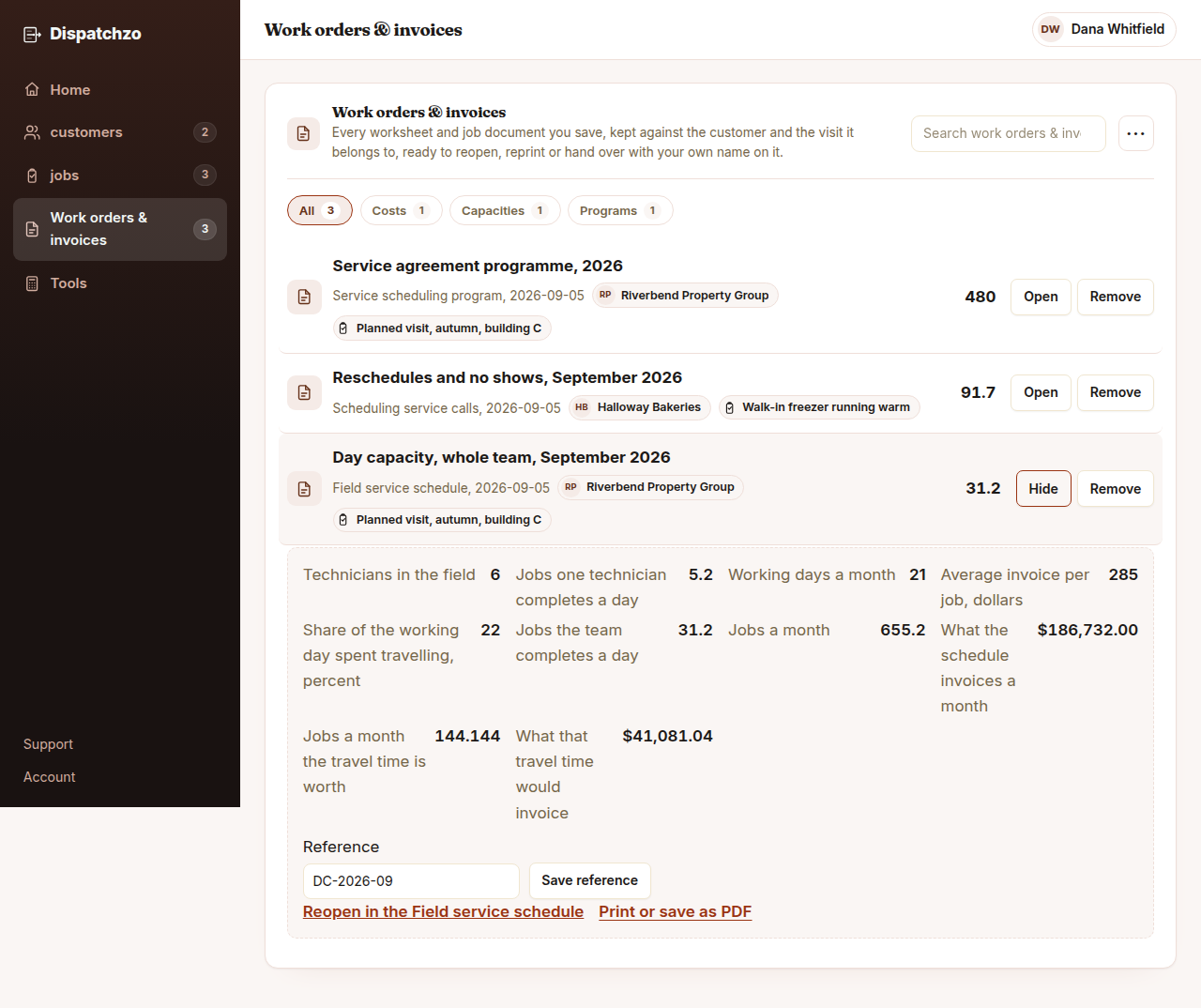
- What that travel time would invoice
- $41,081.04
- Computed on this page from the inputs below
- Jobs the team completes a day
- 31.2
- Computed on this page from the inputs below
- Jobs a month
- 655.2
- Computed on this page from the inputs below
- What the schedule invoices a month
- $186,732
- Computed on this page from the inputs below
Every figure printed on this site is arithmetic on the worked example we publish: 6 technicians completing 5.2 jobs a day across 21 working days at an average invoice of $285, with 22% of the day spent travelling; 655 service calls a month of which 14% are rescheduled at 0.18 hours each by a dispatcher costing $32 an hour and 6% never happen; and 240 service agreements at 2 planned visits a year, 1.3 technician hours each at $58, charged at $145 a visit. Change any of those on a worksheet and the numbers change with them. Nothing here is a market statistic and nothing is quoted from a third party.
Email me this result
We will send you these figures and a link back to them. One email, nothing else unless you tick the box.
These figures start from a worked example ($41,081.04). Put your own week in and the answer changes as you type.
Download the Field service schedule worked example (CSV)
A field service schedule has a ceiling and most businesses have never worked out where it is. The ceiling is technicians multiplied by the jobs one of them genuinely completes in a day, and booking past it does not produce more work, it produces the phone calls that move the work. This worksheet puts a number on the ceiling, on what the month invoices when you hit it, and on the part of the day that goes on driving.
Count jobs completed, not jobs booked
The input is what a technician actually finishes, and the two numbers differ by exactly the amount this worksheet exists to expose. 6 technicians at 5.2 jobs is 31.2 a day and 655 a month, and if your board is carrying more than that then the surplus is not work, it is a queue that will be rebooked at somebody's expense.
Put your own invoice value in, including the small jobs
$285 is the worked example and it is an average, which means it has to include the twenty minute call that billed $95 as well as the install that billed $1,400. Averaging only the good jobs is the commonest way to make this worksheet flatter you, and the flattering version is no use in a budget conversation.
Read the travel line, then look at your map
$41,081 a month of capacity sitting in the van is the argument for clustering jobs by area before clustering them by urgency. It is also a payroll fact rather than a metaphor: travel inside the working day is hours worked, and the Department of Labor is specific about that, so the time is paid whether or not it is billed.
Where the constants in this tool come from
US Department of Labor, 29 CFR 785.33, travel time in general.
US Internal Revenue Service, Publication 463, travel and car expenses.
What a dispatcher asks before running the Field service schedule
Is 5.2 jobs a day realistic? It is deliberately a decimal, because whole numbers are always somebody's good day. Count a normal week including the day that went badly and divide by five. Most teams find a number lower than the one they would have guessed.
Why is travel expressed as a share of the day? Because that is the form the answer is useful in. 22% of a 655 job month is 144 jobs worth of capacity, which is $41,081 at $285 a job, and that is a figure worth arguing about.
Does cutting travel to zero mean earning that? No, and the worksheet does not claim it. Nobody teleports. The figure is what the travel is worth, which is the size of the prize for tighter geographic clustering, not a promise.
Dispatchzo Pro
Keeping the board, not just the answer
You have the number. Pro keeps the board it describes: every job, every technician, every window and every document the job produced.
- Download the finished sheet as a file
- Send it without the Dispatchzo line on it
- Save a sheet and reopen it next month
- Put your company name and logo on it
- Export every customer, job and document at once
- Jobs emailed to whoever is going to them
- Connect your own Stripe account and get paid online
- Connect your QuickBooks Online or Xero
$69per month, whole team
Start Dispatchzo Pro Free for 14 days. No card needed. PricingThe first 14 days are free and no card is asked for. Add a card during the trial and the first charge is on the day it ends; do not, and your workspace becomes read-only with nothing deleted. Dispatchzo Pro is $69 a month and renews automatically each month at $69 until you cancel. There is no minimum term, no per technician charge, and the price does not change on renewal.