Scheduling service calls
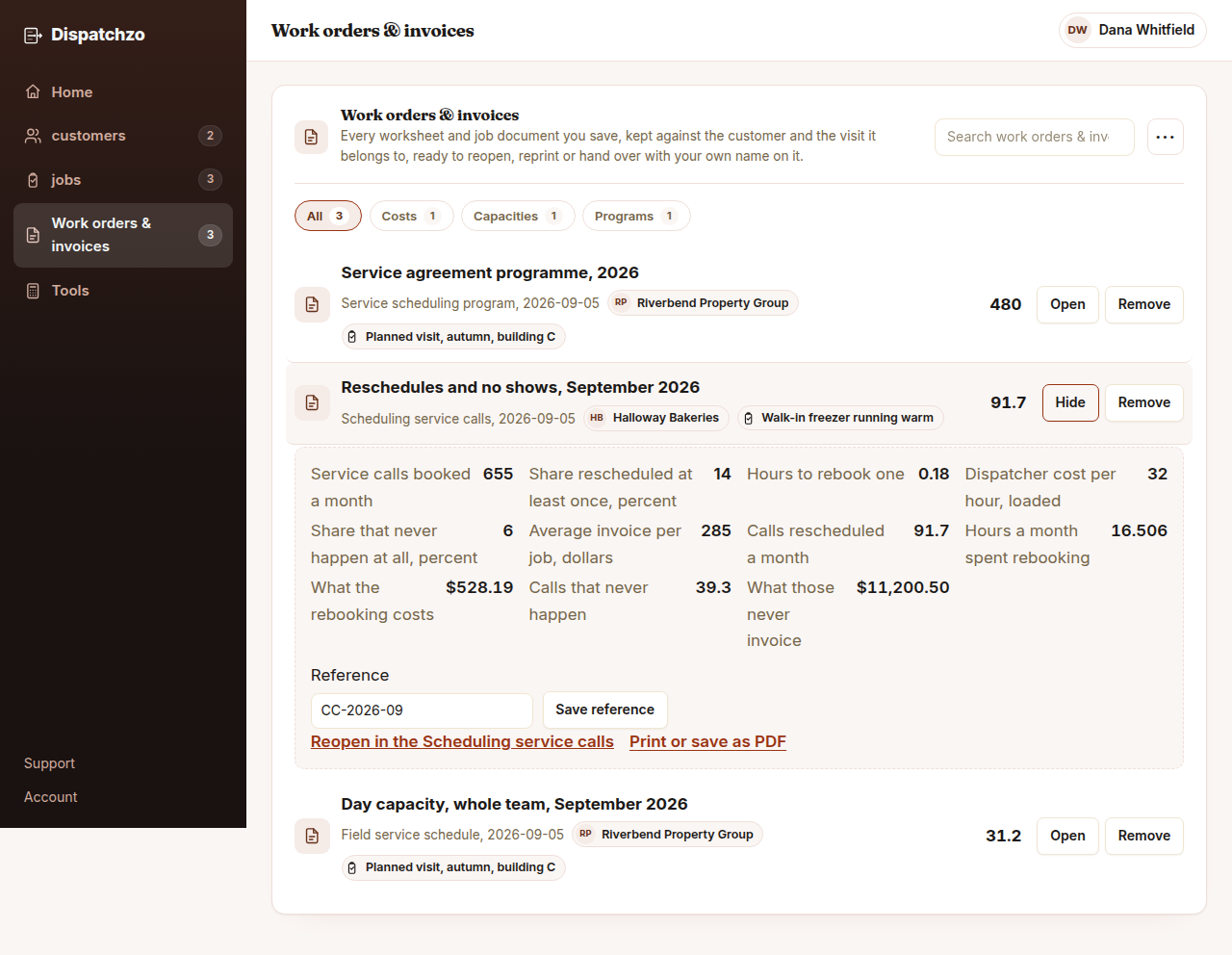
- What those never invoice
- $11,200.50
- Computed on this page from the inputs below
- Calls rescheduled a month
- 91.7
- Computed on this page from the inputs below
- Hours a month spent rebooking
- 16.51
- Computed on this page from the inputs below
- What the rebooking costs
- $528.19
- Computed on this page from the inputs below
Every figure printed on this site is arithmetic on the worked example we publish: 6 technicians completing 5.2 jobs a day across 21 working days at an average invoice of $285, with 22% of the day spent travelling; 655 service calls a month of which 14% are rescheduled at 0.18 hours each by a dispatcher costing $32 an hour and 6% never happen; and 240 service agreements at 2 planned visits a year, 1.3 technician hours each at $58, charged at $145 a visit. Change any of those on a worksheet and the numbers change with them. Nothing here is a market statistic and nothing is quoted from a third party.
Email me this result
We will send you these figures and a link back to them. One email, nothing else unless you tick the box.
These figures start from a worked example ($11,200.50). Put your own week in and the answer changes as you type.
Download the Scheduling service calls worked example (CSV)
Two things happen to a booked service call that nobody costs: it moves, or it evaporates. Both feel like friction rather than money, which is why they run for years unmeasured. This worksheet separates them. The rescheduling figure is dispatcher time and it is small. The no show figure is invoicing that was booked and never happened, and it is usually twenty times larger.
Separate the two costs, because they argue for different things
91.7 reschedules a month at 0.18 hours is 16.5 hours and $528 of dispatcher time. 39.3 no shows at $285 is $11,200 of invoicing. The first buys you a better board. The second buys you reminders, confirmations and a deposit policy, and it is the one worth taking to a meeting.
Use a loaded dispatcher rate, not a wage
$32 an hour is meant to include the employer cost of employing somebody, not just what lands in their account. Payroll taxes and the rest of it are set out in the Internal Revenue Service employer guide, and using the bare wage understates every figure the worksheet produces by roughly a third.
Test the reminder before you buy it
Drop the no show share from 6% to 3% in the worksheet and read what changes. If the difference is larger than the annual cost of the software, which on this example it comfortably is, you have your business case in one line and you did not need a case study to get there.
Where the constants in this tool come from
US Internal Revenue Service, Publication 15, employer's tax guide.
US Department of Labor, Fact Sheet 23, overtime pay requirements.
What a dispatcher asks before running the Scheduling service calls
Why is rebooking only 0.18 hours? It is about eleven minutes, which covers the call, the shuffle and telling the technician. Put your own figure in if your rebooking also means ringing the two other customers who now move, because then it is considerably more.
Is a 6% no show rate high? It is ordinary for work booked more than a few days out with no reminder, and it falls sharply with one. That is the whole argument for automated reminders, and the worksheet lets you test it by changing one number.
Should I count the no show as lost revenue? As lost invoicing for that slot, yes. Whether it is lost forever depends on whether the job comes back, which is why the output is labeled what those never invoice rather than profit.
Dispatchzo Pro
Keeping the board, not just the answer
You have the number. Pro keeps the board it describes: every job, every technician, every window and every document the job produced.
- Download the finished sheet as a file
- Send it without the Dispatchzo line on it
- Save a sheet and reopen it next month
- Put your company name and logo on it
- Export every customer, job and document at once
- Jobs emailed to whoever is going to them
- Connect your own Stripe account and get paid online
- Connect your QuickBooks Online or Xero
$69per month, whole team
Start Dispatchzo Pro Free for 14 days. No card needed. PricingThe first 14 days are free and no card is asked for. Add a card during the trial and the first charge is on the day it ends; do not, and your workspace becomes read-only with nothing deleted. Dispatchzo Pro is $69 a month and renews automatically each month at $69 until you cancel. There is no minimum term, no per technician charge, and the price does not change on renewal.